
Introducing AIMS – a framework for evidencing the difference your community makes
This week I gave a talk for Led By Community’s Leading Communities with Purpose series, called Beyond vanity metrics. Thank you to everyone who came, asked questions and shared their thinking in the chat. This post is for anyone who wants to keep the conversation about measuring community impact going – or who couldn’t make it.
Most nonprofit online communities are measured by what’s easy to count:
- Registrations
- Active members
- Posts
- Session length
Those numbers matter – they tell you the lights are on. But they don’t tell you whether anyone’s life is better for being there. And that’s usually what funders and leaders really want to know, even if it’s not what they ask for.
So in this post I’m sharing the framework I use to measure impact in a way that matters, how it came about, and how you can start using it – even if your data has gaps.
How AIMS came about
I’ve been building communities with nonprofits for over 15 years. At Alzheimer’s Society I helped scale a peer support community from 20,000 to over 85,000 members. That’s the number that goes in my bio. But it was never the number that mattered most.
What mattered was whether a carer at 2am found someone who understood. Whether someone made a decision they felt more confident about. Whether they felt less alone.
I knew that. What I didn’t have was a helpful way to describe it.
That gap came up again while I was writing a strategic recommendations report for a client. They wanted to understand where their community was now and what it could become. But they’d got stuck reporting activity, and didn’t know what else to measure.
Measuring community impact is one of the most common issues I see. Leaders know the community matters. But they rarely ask for – or receive – tangible evidence of its value beyond activity numbers. And I’m often brought in for an operational or tactical project, only to find the real issue is a strategic one. Projects about efficiency sometimes turn out to be about effectiveness.
So I went looking for good practice on measuring community impact. And I realised how much of it was written for B2B and for-profit communities. Very little of it fitted a nonprofit context – and almost none of it fitted communities of circumstance, built around crisis, caregiving, a health condition or a life change people didn’t choose.
I went back through previous projects and started mapping what had actually worked. Four themes kept coming up that described different aspects of measuring community impact. When I put them side by side, the word they spelled made perfect sense: AIMS.
Behind it is a phrase that’s well known in monitoring and evaluation – and one I learned the hard way:
Measure what you value, rather than valuing what you measure.
Why the usual playbooks don’t translate
Most measurement advice in community building comes from two places:
- Social media – reach, impressions, followers, likes and engagement rate. These measure attention.
- B2B and product communities – questions answered, support tickets deflected, retention and revenue influenced. These measure how well the community serves the business.
Both are legitimate in their own context. But they share an assumption: that the community exists to serve the organisation.
Nonprofit communities have to serve members and the organisation. The balance shifts – often a long way – toward member need. In many cases, the community exists to serve the community.
That changes what success looks like. In a product community, a member who asks a question, gets an answer and leaves is a win. In a peer support community, the same pattern might mean they didn’t find what they needed, or didn’t feel they belonged. Cancer, crisis and caregiving aren’t a one-question-and-answer situation.
And it cuts both ways. A long session might be great engagement – or someone in distress at 3am. A member going quiet might have disengaged. Or be coping better. Or the person they cared for may have died.
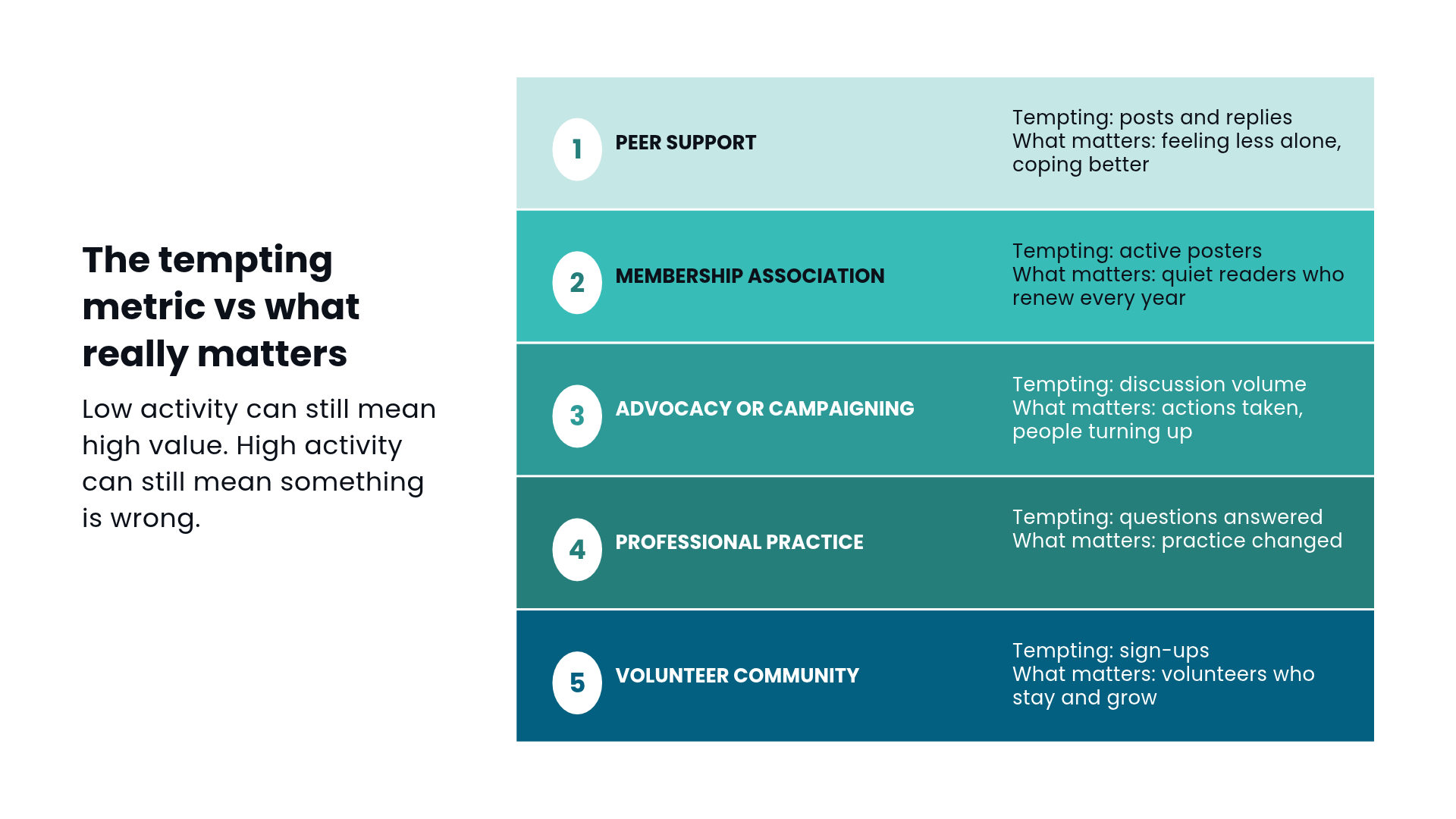
The same number can mean opposite things. Low activity can still mean high value. High activity can still mean something is wrong.
It isn’t only true of peer support.
The playbooks aren’t wrong. They were just written for a different type of community.
The AIMS framework
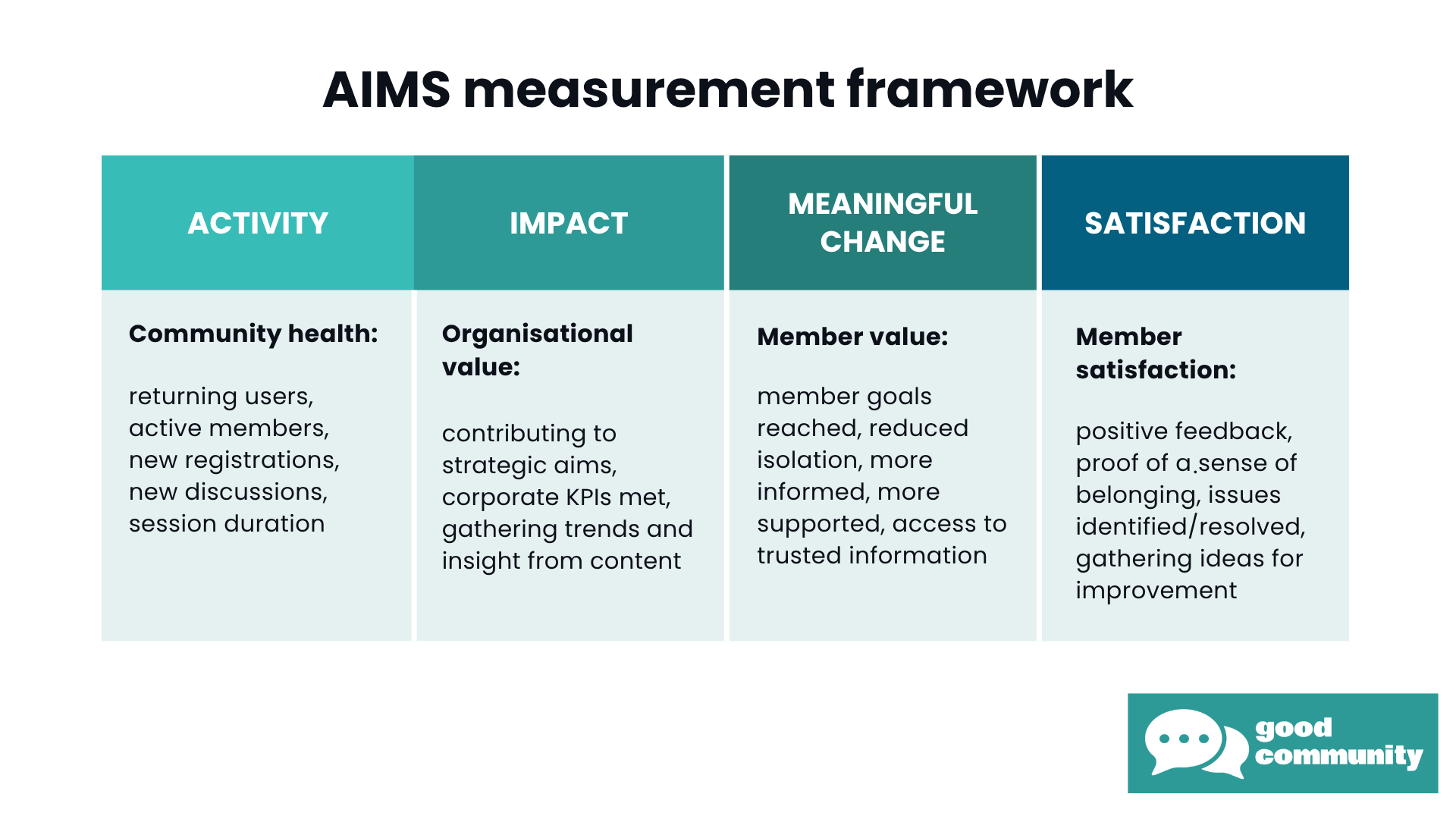
AIMS isn’t a template to copy. It’s a way to measure community impact across four areas. It keeps the numbers, but puts them in context. Beyond vanity metrics doesn’t mean throwing activity data away – it means not stopping there.
A – Activity. The community health baseline: returning users, active members, new registrations, new discussions, session duration. Are people coming back? Return visits tell you more than sign-ups.
I – Impact. The value to the organisation: contributions to strategic aims and KPIs, plus the trends and insight from what members talk about. For example, themes from the community shaping a service, a resource or a policy response.
M – Meaningful Change. The difference in members’ lives: member goals reached, reduced isolation, feeling more informed and supported, access to trusted information. Mostly captured through member surveys and feedback.
S – Satisfaction. How the experience feels to members: positive feedback, an evidenced sense of belonging, issues identified and resolved, and ideas for improvement.
One thing to know upfront: the acronym order isn’t the build order. Activity is usually the easiest to fill. Impact and Meaningful Change are usually the hardest.
How to use AIMS
There’s no one right way to measure a community. What you measure has to come from your organisation’s context and what your members need. But here’s where I’d start.
1. Define what the community is for
We often rush to measurement because someone has asked for numbers. But measurement requires definition. Before choosing a single metric, finish this sentence:
This community exists so that members can…
That sentence is your measurement specification. Everything you measure should connect back to it. If you can’t write it yet, you’re not ready to measure – and that’s useful to know.

2. Find your sweet spot
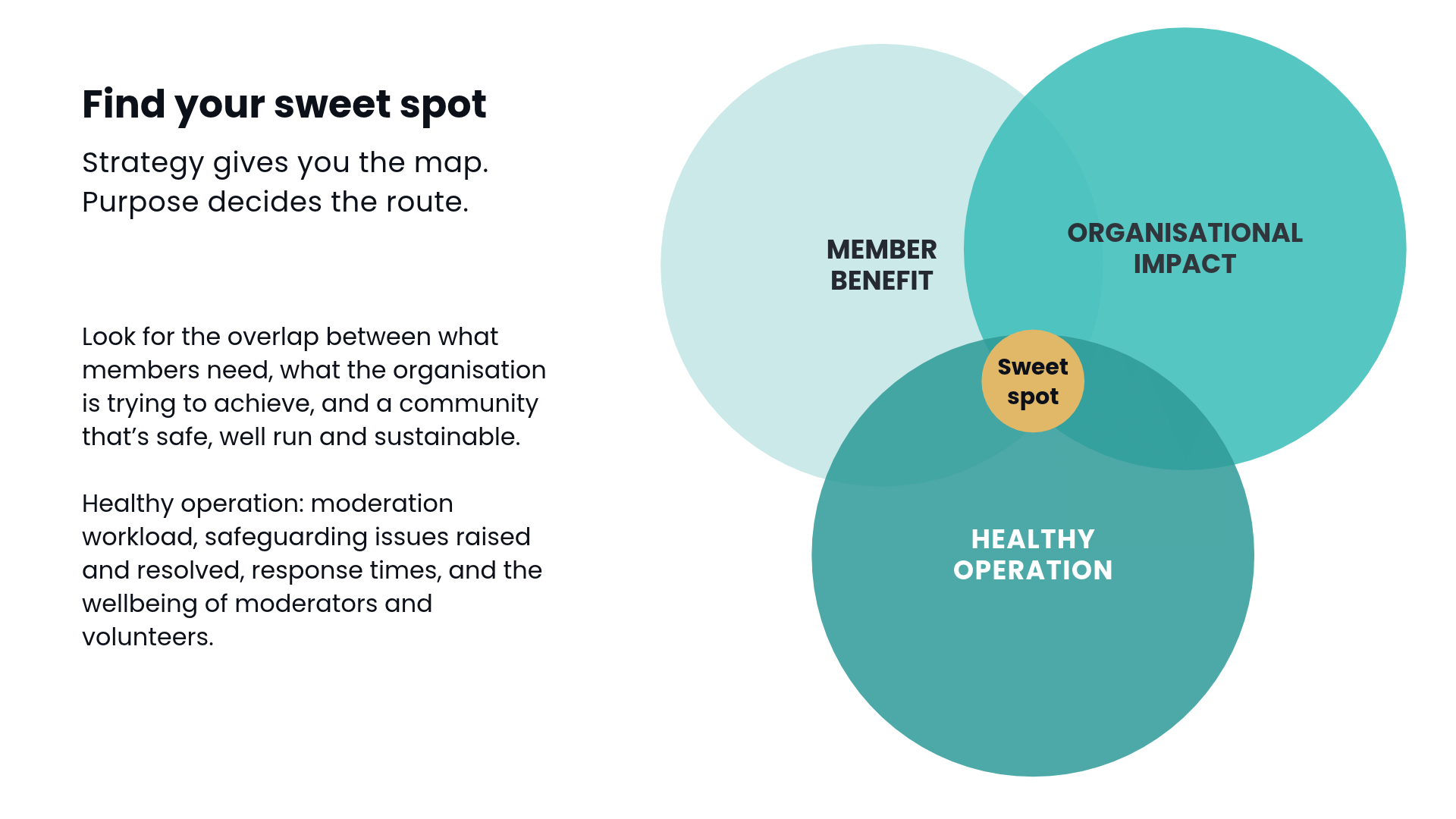
Start with how your organisation already measures impact. Look at the strategy and its KPIs, what the annual report celebrates, what leaders keep asking about – and what members care about.
Then look for the overlap between three things:
- member benefit
- organisational impact
- healthy operation – a community that’s safe, well run and sustainable
Healthy operation is the one most often left out. Moderation workload, safeguarding issues raised and resolved, response times, and the wellbeing of the moderators and volunteers who keep the community going. If the people holding a community up are burning out, no other metric will stay healthy for long.
Now narrow down. Hold what you’ve found up against your sentence. What genuinely fits, and what can you actually evidence – through stats, through actions people take, or through feedback?
Organisational strategy gives you the map. The community’s purpose decides the route. And if in doubt, ask. Colleagues in social media, evaluation, customer care and fundraising are often measuring similar things already.
3. Measure the difference members want to see
Meaningful Change is the part people find hardest. Start with members’ goals, not yours. What difference do they want to see in their lives as a result of taking part?
Two approaches I find useful:
- Sense of community. McMillan and Chavis describe it through four elements: membership, influence, fulfilment of needs, and shared emotional connection. The full Sense of Community Index is long, so pick a few questions that map to each element.
- Personal change statements. Ask members how far they agree with statements such as “Since joining, I feel less alone”, “I feel better able to cope with…” or “I’ve applied something I learned here in my work.”
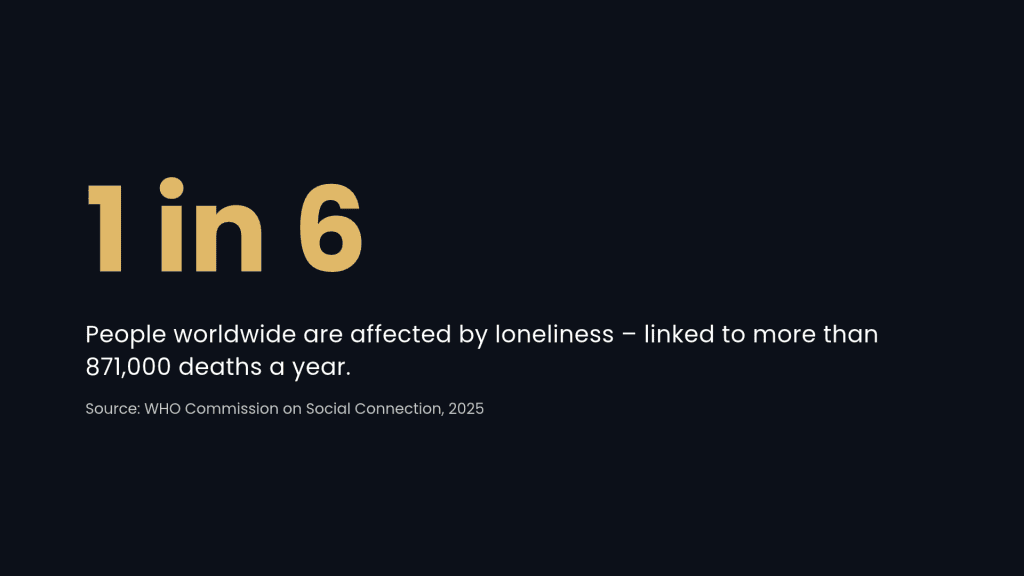
This matters. Kasley Killam describes social health as the third pillar of wellbeing, alongside physical and mental health. And the World Health Organization’s Commission on Social Connection estimates that around 1 in 6 people worldwide are affected by loneliness.
4. Ask well
One of the questions I’m asked most is how to track change without members feeling watched. The good news is that members generally want to be asked. They want to feel heard (I’ve written more about the art of listening to your community). So don’t be afraid to ask – just ask well:
- Ask intentionally – know why you’re asking and what you’ll do with the answer.
- Don’t over-ask – fewer, better questions, at sensible intervals.
- Give something back – even a small thank you shows you value people’s time.
- Make it easy – offer examples of common benefits, then leave space for members to add their own.
- Gather with consent – tell people how answers will be used, ask before quoting anyone, and anonymise by default.
A useful test for any question: can you explain to a member, in one sentence, why answering it is good for them? If you can’t, rethink it.

5. Start small, and be honest about the gaps
You won’t fill every part of AIMS at once, and you don’t need to. For many nonprofits, Impact is the hardest. For communities of circumstance, it’s almost always Meaningful Change – change takes time, asking people in difficult circumstances is sensitive, and it’s hard to separate the community’s role from everything else in someone’s life.
So start where you are:
- You’re probably measuring activity already.
- Add popular topics and trends – what members are talking about.
- Add member feedback.
- Over time, build in deeper insight from conversations, an annual survey or focus groups.
If you want a simple way to build this up over time, try plan, do, review.
A framework that claims to fill everything is technically complete and practically useless. Measurement that respects members’ trust will look slower and more qualitative than the playbooks suggest. That’s not a weakness of the framework. It’s the framework working.
Insights can fuel change
Measurement isn’t only about proving value. Good insight can build the case for funding and growing a community. It can reshape a service or a resource. It can even contribute to policy change – at Alzheimer’s Society, what we heard through community engagement helped build the case for Blue Badges for people with dementia.
That’s the point of measuring what matters. Not a better dashboard – a better outcome for the people the community exists for.

Let’s keep talking
I’d love to hear how this lands for you. Here are a few questions to guide your thinking:
- How confident do you feel measuring the impact of your community?
- Which of the four AIMS areas is emptiest for you right now?
- What’s the most persuasive piece of evidence you’ve ever shared, and why did it land?
- What do you wish leaders understood about the value of your community?
Share your thoughts in the comments, or find me on LinkedIn – I’m sharing more about building successful nonprofit communities over the coming weeks, so follow along if that’s useful.
Want help measuring what matters?
My skill set – and my passion – is helping people demonstrate meaningful impact for the communities they care about. That includes:
- Teaching impact measurement – training for community teams on defining purpose, choosing measures and asking well
- Auditing community health and reporting – a fresh look at what you measure now, what it’s telling you, and what’s missing
- Building more meaningful measurement with you – shaping a framework, survey questions and reporting that fit your community and your organisation
I have availability for new work from February 2027. If any of this sounds useful, get in touch – I’d be happy to talk it through.
Thanks for reading,
Serena
Further reading
Social connection and loneliness
Sense of community
- Sense of Community Index 2 (SCI-2) – Website for information on the sense of community index, based on a theory presented by McMillan and Chavis (1986)
Impact practice in the charity sector
- NPC – The Code of Good Impact Practice – helpful as a general benchmark on impact practice
Community measurement more broadly
- The Community Roundtable – State of Community Management – features other types of online communities, useful as a contrast